
Prepared for the Free From Bedbugs Programme
June 2026
Table of contents
1. Executive summary
2. Key findings
3. Evidence base and method
4. The social impact of bed bugs
5. The prevention gap
6. Bed bugs as a poverty multiplier
7. The Free From Bedbugs model
8. Economic and SROI framework
9. ESG outcomes framework
10. Deployment scenarios
11. Recommendations
12. Research integrity statement
13. Appendices and references
1. Executive summary
Bed bugs are often described as a pest-management problem. This framing is incomplete. Infestations can disrupt sleep, contribute to anxiety, generate household costs, increase stigma, place pressure on housing providers and hospitality operators, and create avoidable environmental impacts through repeated intervention and discarded furnishings.
The strongest published evidence concerns resurgence, insecticide resistance, clinical relevance, sleep disturbance, anxiety, psychological distress, and quality-of-life impacts. Wider claims concerning housing inequality, education, environmental outcomes, and poverty effects are evidence-informed and require further direct measurement. This report therefore treats these areas as social-impact frameworks for programme evaluation rather than settled scientific consensus.
The central proposal is that prevention and early detection should be treated as social infrastructure. In the same way that smoke alarms, carbon monoxide alarms, and water-leak sensors reduce harm by identifying risk early, bed bug monitoring can reduce the time between introduction and action. When detection occurs earlier, social, financial, operational and environmental burdens are likely to be lower.
The Free From Bedbugs programme is designed around a simple intervention logic: make low-cost monitoring accessible, educate residents and site managers, create clear reporting pathways, and measure outcomes transparently. The model uses a £15 monitor cost as the baseline deployment assumption for illustrative economic modelling.
2. Key findings
| Finding | Implication | Evidence confidence |
|---|---|---|
| Bed bugs have resurged internationally and are difficult to control. | Prevention and early detection deserve more attention alongside treatment. | High |
| Infestations are associated with sleep disturbance and psychological distress | The burden is not limited to bites or property damage. | High |
| Households with fewer resources may experience greater disruption. | Prevention has an equity dimension. | Moderate |
| Delayed detection increases direct and indirect costs | Monitoring can be evaluated as cost avoidance | Moderate to high |
| Environmental and ESG benefits are plausible but need programme data | Impact reporting should be built into deployment. | Emerging |
3. Evidence base and method
This report uses a multidisciplinary evidence base: entomology, public health, housing policy, social determinants of
health, sustainability reporting, and social value measurement. Published studies document the modern resurgence
and insecticide resistance of bed bugs, their clinical relevance, and evidence of mental-health and sleep impacts.
Public-health and social determinants literature is used to interpret how household-level disruptions may interact with
vulnerability, housing instability and poverty.
Social impact measurement is guided by Social Value International’s SROI approach, which provides a framework for
measuring, managing and accounting for social value. ESG alignment is framed against recognised reporting concepts
such as the Global Reporting Initiative, which is designed to help organisations report impacts on the economy,
environment and people
| Evidence level | Use in this pape | Example |
|---|---|---|
| Established evidence | Directly supported by published literature. | Resurgence, resistance, clinical relevance, sleep disturbance, anxiety |
| Evidence-informed interpretation | Supported by related literature and reasoned inference. | Housing burden, productivity effects, education consequences. |
| Proposed framework | A model for evaluation and programme design. | Poverty Multiplier, Prevention Gap, ESG Outcomes Model. |
4. The social impact of bed bugs
Mental health and wellbeing
The psychological burden of bed bugs has been documented in public-health and clinical literature. A Montreal
cross-sectional study found that exposure to bed bugs was associated with sleep disturbance and symptoms of anxiety
and depression. Clinical commentary and reviews also describe anxiety, insomnia, hypervigilance, avoidance
behaviours and psychological distress in affected people.
This matters because sleep and wellbeing are not peripheral outcomes. They influence concentration, family
functioning, productivity, and capacity to manage other pressures. In practical terms, even when an infestation is
biologically small, the perceived risk can dominate household life.
Housing and vulnerability
Bed bugs are not caused by poverty, and they can affect any household. The consequences, however, are not evenly
distributed. Households with savings, control over their accommodation, access to reliable advice and rapid
professional help are better positioned to respond. Households in insecure, temporary, supported, or low-income
housing may face barriers to reporting and resolution.
This is where bed bugs intersect with social determinants of health. The WHO defines social determinants as the
conditions in which people are born, grow, live, work and age, and people’s access to power, money and resources.
Bed bugs should not be described as a primary social determinant, but infestations can interact with these
determinants by adding stress, cost and disruption.
Education, productivity and community effects
Direct bed bug-specific evidence on education and productivity remains limited. However, the pathway is plausible and
should be measured: infestation anxiety and nocturnal disturbance can affect sleep; sleep affects concentration and
daytime performance; family stress can affect attendance and routines. Community effects may include stigma,
neighbour disputes, delayed reporting and increased organisational workload.
5. The prevention gap
Most bed bug expenditure is reactive. Money is spent once a case has escalated: inspection, treatment, replacement
items, complaint management, room closure, rehousing, and reputational repair. By contrast, routine prevention and
early detection are often treated as optional.
This report defines the Prevention Gap as the imbalance between the scale of avoidable harm caused by delayed
detection and the comparatively low level of investment in early warning systems.

The chart above is illustrative rather than a claim of fixed costs. It shows the principle that total burden can rise sharply
as detection is delayed. The same logic applies in fire safety, water damage, public health screening, and many other
fields: early warning reduces harm.
6. Bed bugs as a poverty multiplier
The Poverty Multiplier framework is one of this report’s central contributions. It does not claim that bed bugs cause
poverty. Rather, it proposes that infestations can amplify existing vulnerability through a chain of stress, cost and
disruption.

A household already close to financial pressure may be pushed into debt by treatment costs or discarded furniture.
Sleep disruption may affect work. Housing stress may worsen relationships with landlords or neighbours. Stigma may
delay reporting. These effects can combine and reinforce disadvantage.
7. The Free From Bedbugs model
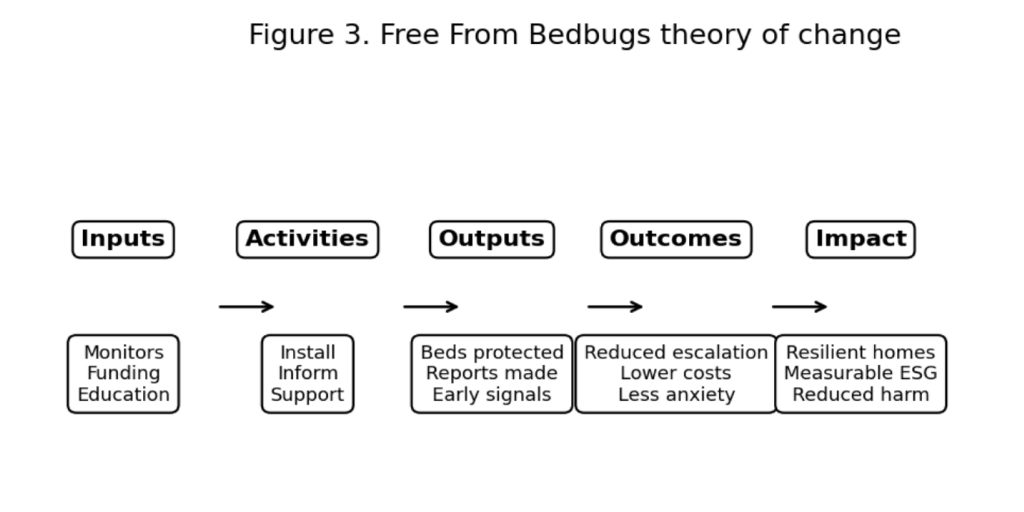
The Free From Bedbugs model is a prevention-led framework built on four components: accessible monitoring,
education, early reporting and transparent impact measurement. The model uses passive monitoring and routine checking as the first line of community protection.
A key operational assumption used for modelling is one £15 monitor per protected sleeping area. This allows funders
to understand deployment costs in simple terms and compare them against avoided treatment, replacement,
operational and social costs.
8. Economic and SROI framework
The economic case for prevention should not rely only on treatment savings. A broader social value model should
include direct, indirect and intangible outcomes. Social Value International’s SROI guidance is useful because it
encourages organisations to account for social, environmental and economic value, while avoiding over-claiming
| Value category | Possible measure | Notes |
|---|---|---|
| Direct cost avoidance | Treatment, inspection, replacement items. | Most easily monetised. |
| Operational savings | Staff time, room closure, complaint management. | Important for housing and hotels. |
| Productivity protection | Lost days avoided, sleep-related performance effects. | Should be conservatively modelled. |
| Wellbeing benefits | Anxiety and sleep self-report scores. | Measure first; monetise cautiously. |
| Environmental value | Furniture retained, treatments avoided, travel reduced. | Useful for ESG reporting. |

Illustrative deployment examples: one bed = £15 per year; a three-bed household = £45 per year; a 500-unit housing
portfolio with three protected sleeping areas per unit = £22,500 per year; a 100-room hotel with two protected beds per
room = £3,000 per year. These figures exclude programme administration, training, fulfilment and evaluation costs,
which should be modelled separately for grant applications.
9. ESG outcomes framework
The ESG case is strongest when framed as measurable impact rather than marketing language. Environmental
outcomes may include reduced waste and reduced treatment intensity. Social outcomes may include improved sleep,
reduced anxiety, earlier reporting and protected housing stability. Governance outcomes may include transparent data
capture, verification, audit trails and annual reporting.
| ESG pillar | Relevant outcomes | Suggested KPI |
|---|---|---|
| Environmental | Less waste, fewer unnecessary interventions, fewer discarded furnishings. | Items retained; treatments avoided; estimated kg waste avoided. |
| Social | Wellbeing, sleep, reduced stigma, household resilience | Households protected; early detections; self-reported anxiety reduction. |
| Governance | Transparency, measurement, verification, learning. | . QR verification rate; completed checks; published impact report. |
10. Deployment scenarios
| Scenario | Deployment | Primary value proposition |
|---|---|---|
| Low-income household | One monitor per bed; education; reporting pathway. | Reduce escalation, anxiety and replacement costs |
| Social housing portfolio | Routine monitor installation across high-risk units. | Reduce complaints, spread, treatment intensity and tenant disruption. |
| Supported accommodation | Monitoring with staff training and simple checks. | Protect vulnerable residents and improve confidence. |
| Hotel | QA monitoring in rooms with incident protocol. | Protect reputation, minimise room downtime, reduce guest complaints. |
| Local authority pilot | Targeted deployment in priority housing groups. | Generate public-health and housing evidence for scale-up. |
11. Recommendations
For foundations and ESG funders
Fund a structured pilot rather than a general awareness campaign. Require baseline data, deployment records, early
detection outcomes, resident feedback and an annual impact report. Fund independent review where possible.
For housing providers
Integrate monitoring into routine property risk management. Reduce stigma through resident education. Measure
complaints, detection stage, treatment intensity and furniture loss before and after deployment.
For local authorities
Consider bed bug prevention within housing resilience and public-health prevention strategies. Target pilots at
temporary accommodation, supported housing and households facing financial vulnerability.
For hospitality organisations
Treat monitoring as quality assurance. The business value lies not only in detection but in documented due diligence,
reduced room downtime and more confident incident management.
12. Research integrity statement
This report is not a claim that bed bugs are the sole or principal cause of poverty, poor mental health, educational
disadvantage, housing insecurity or community stress. It argues that infestations can contribute to these outcomes and
can amplify existing pressures. Strong claims should be supported by direct evidence; emerging claims should be
treated as hypotheses for programme evaluation.
The report’s strongest evidence-supported claims concern resurgence, clinical relevance, resistance, sleep
disturbance and psychological distress. Its most original frameworks – the Prevention Gap and Poverty Multiplier –
should be tested through pilots, outcome tracking and external evaluation.
13. Appendices
Appendix A: Minimum impact dashboard
| Domain | Metric |
|---|---|
| Reach | Households enrolled; beds protected; monitors installed. |
| Detection | Suspected activity reported; confirmed early detections; escalation rate. |
| Social | Sleep confidence; anxiety rating; resident satisfaction. |
| Economic | Treatment costs avoided; furniture replacement avoided; room downtime avoided |
| Environmental | Items retained; interventions avoided; estimated waste avoided. |
| Governance | QR verification; check compliance; annual reporting. |
Appendix B: Suggested pilot design
A practical first pilot could protect 1,000 households for 12 months. Using a three-sleeping-area household
assumption, monitor cost would be £45,000 before fulfilment, training, administration and evaluation. Baseline and
follow-up data should be collected on reports, confirmed detections, treatment intensity, furniture loss, resident anxiety
and satisfaction.
Appendix C: Limitations
Evidence on mental health is stronger than evidence on community-level economic and environmental impacts.
Environmental savings should not be overstated until measured. Productivity and education outcomes should be
treated as plausible pathways, not quantified claims, unless direct data are collected. The £15 monitor model is a
deployment-cost assumption, not a complete programme cost.
References
Doggett, S. L., Dwyer, D. E., Peñas, P. F., & Russell, R. C. (2012). Bed bugs: clinical relevance and control options. Clinical Microbiology
Reviews, 25(1), 164-192. https://doi.org/10.1128/CMR.05015-11
Susser, S. R., Perron, S., Fournier, M., Jacques, L., Denis, G., Tessier, F., & Roberge, P. (2012). Mental health effects from urban bed bug
infestation: a cross-sectional study. BMJ Open, 2(5), e000838. https://doi.org/10.1136/bmjopen-2012-000838
Romero, A., Potter, M. F., Potter, D. A., & Haynes, K. F. (2007). Insecticide resistance in the bed bug: a factor in the pest’s sudden
resurgence? Journal of Medical Entomology, 44(2), 175-178.
Dang, K., Doggett, S. L., Singham, G. V., & Lee, C. Y. (2017). Insecticide resistance and resistance mechanisms in bed bugs. Insects, 8(3),
83.
Ashcroft, R., Seko, Y., Chan, L. F., Dere, J., Kim, J., & McKenzie, K. (2015). The mental health impact of bed bug infestations: a scoping
review. International Journal of Public Health, 60, 827-837.
Fung, E. H. C., et al. (2021). Bed bug exposure, self-rated health and wellbeing. Public-health literature cited for wellbeing impact pathway.
World Health Organization. Social determinants of health. WHO health topic page.
Marmot, M. (2010). Fair Society, Healthy Lives: The Marmot Review. Institute of Health Equity.
United Nations. Transforming our world: the 2030 Agenda for Sustainable Development and the Sustainable Development Goals.
Global Reporting Initiative. GRI Standards: global standards for sustainability impacts.
Social Value International. A Guide to Social Return on Investment.
Doggett, S. L. (2023). Historical and contemporary control options against bed bugs. Annual Review of Entomology